How to Find a Reliable Fence Company Near You in Massachusetts or New Hampshire
Updated: 7 days ago
Finding a reliable fence company in Massachusetts or New Hampshire takes more than choosing the first result for a search such as "reliable fence company near me." A dependable contractor should be able to explain the right material for your property, communicate clearly, account for local site conditions, provide a detailed written scope, and make the consultation feel informative rather than pressured.
Comparing fence companies for your property? Call Northstar Fence & Rail at (603) 453-3698 for a free, no-obligation consultation.
This guide explains what to look for before hiring a contractor for a residential, commercial, pool, gate, repair, or restoration project. For an overview of Northstar Fence & Rail's Massachusetts and New Hampshire fence installation services, visit the company website.
What should you look for in a reliable fence company?
A reliable fence company combines relevant experience, honest communication, suitable materials, careful site planning, clear documentation, and verifiable trust signals. The best contractor is not necessarily the one with the biggest advertisement or the lowest initial quote. It is the one that can show how its recommendation fits your property and explain what happens next.
- Relevant project experience:
Look for work similar to yours, such as privacy fencing, pool enclosures, gates, commercial boundaries, or fence repair.
- Local planning knowledge:
Massachusetts and New Hampshire properties can involve rock, ledge, slopes, wooded access, ponds, drainage concerns, frost movement, and town-specific requirements.
- Clear communication:
The contractor should answer questions directly, identify assumptions, and explain who will handle each part of the project.
- A written scope:
Your documents should identify the fence type, height, layout, gates, materials, preparation, cleanup, and responsibilities.
- Appropriate insurance and credentials:
Ask what applies to your project and request documentation rather than relying on a verbal assurance.
- A useful consultation:
You should leave with a clearer understanding of your options, not pressure to sign before you are ready.
These criteria help separate a contractor that is prepared to manage a project from one that is mainly focused on generating a quick deposit.
How can you verify a fence company's experience and local knowledge?
Ask a prospective contractor to explain how it approaches your type of property, material, and project complexity. A reliable fence company should be comfortable discussing residential and commercial work, gates, repairs, pool-area planning, and the conditions that can affect a fence after installation.
For example, a property in the Merrimack Valley may have different access, soil, or ledge considerations from a suburban lot in Southern New Hampshire. A wooded parcel, a steep grade, a stone wall, or a drainage path can affect equipment access, post locations, and the final layout. Coastal exposure and open fields can also change how a fence and gate should be planned. Those factors should be part of the conversation before a material is treated as the obvious answer.
Review the contractor's portfolio with a critical eye. Look for projects that show the full system, including posts, corners, gates, transitions, and how the fence meets the terrain. If you need a privacy fence, ask about privacy work. If you need a pool enclosure, ask how the company considers gates and local requirements. If you need storm-damage repair, ask how it decides between a section replacement, restoration, and a larger rebuild.
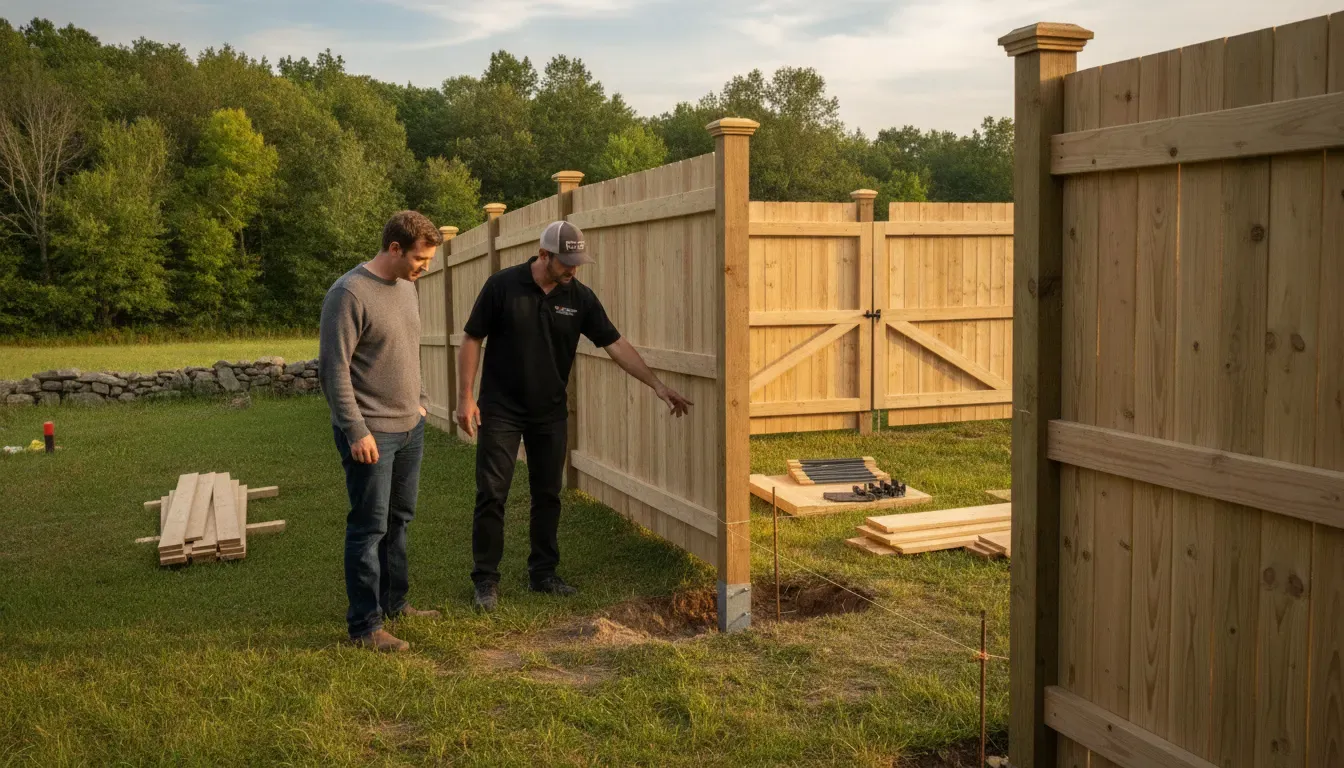
A company should also be able to describe its communication process. Ask who measures the property, who answers questions after the consultation, how changes are documented, and whether the person presenting the recommendation understands the installation details. Good communication is not a substitute for craftsmanship, but unclear communication can undermine even a well-designed project.
What should a written fence estimate or proposal include?
A written proposal should make the project understandable before you agree to move forward. It should connect the recommended fence to your property's needs and clearly identify what is included, what is excluded, and which items still require confirmation.
Proposal detail | What to confirm |
Project scope | Fence location, approximate layout, height, access points, removal, preparation, and cleanup. |
Materials and design | Material, style, color or finish, post and panel details, gate type, hardware, and any screening. |
Site conditions | Rock, ledge, slopes, drainage, trees, existing walls, utilities, access limitations, and other factors that may affect the work. |
Permits and requirements | Which local approvals, HOA reviews, utility-locate steps, or property-line questions apply, and who is responsible for each. |
Schedule and communication | Expected next steps, decision points, project contact, and how changes will be documented. |
Payment and protections | Payment schedule, cancellation terms where applicable, warranty language, and how concerns are handled after installation. |
Do not compare proposals by a single total alone. Two estimates may describe different fence heights, grades, gate hardware, site preparation, removal work, or permit responsibilities. A reliable contractor will explain those differences instead of making the comparison harder.
Have two proposals that are difficult to compare? Call Northstar Fence & Rail at (603) 453-3698 to discuss the questions you should ask before selecting a fence plan.
Which trust signals should you verify before hiring?
Trust signals are useful only when they can be checked. Ask the company for the credentials, insurance information, written terms, and references that are relevant to your project. Massachusetts provides a Home Improvement Contractor Program with homeowner resources and contractor lookup tools, while the New Hampshire Insurance Department advises homeowners to request a certificate of insurance and confirm that coverage is current.
- State or local registration:
Ask what registration, license, or municipal requirements apply to the work and how you can verify them.
- Insurance:
Request current documentation from the insurer or agent, not only a verbal statement. Confirm that the business name and policy dates match the project.
- Subcontractor coverage:
If other crews or trades will work on the property, ask how their insurance and responsibilities are handled.
- Written warranty terms:
Ask what is covered, for how long, what is excluded, and how a claim is submitted. Do not accept "lifetime" or "guaranteed" language without the actual terms.
- Reviews and references:
Read recent reviews for comments about communication, site preparation, cleanup, and how problems were resolved, not just star ratings.
- Business identity:
Make sure the legal or operating name on your documents matches the company you are hiring and the party responsible for the work.
For Massachusetts homeowners, the Massachusetts Home Improvement Contractor Program is a useful starting point for understanding registration and homeowner resources. The state also publishes home improvement contract guidance. New Hampshire homeowners can review the New Hampshire Insurance Department's contractor insurance guidance. These resources do not replace legal advice or a review of your town's requirements, but they can help you ask better questions.
What are the red flags of a low-quality fence contractor?
Warning signs usually appear in the process before they appear in the finished fence. Be cautious when a contractor avoids basic questions, gives a vague proposal, or pushes you to decide before the scope and responsibilities are clear.
The company will not identify who is responsible for the work or who will be on your property.
The proposal is a one-line total with no material, layout, gate, removal, or site-condition details.
The contractor discourages you from checking insurance, permits, references, or written warranty terms.
The recommendation changes sharply without an explanation of the property conditions or project goals.
The contractor promises a universal installation method for every soil type, slope, or fence material.
The company insists on a rushed decision or uses pressure rather than answering reasonable questions.
Communication becomes difficult before the work begins, with missed calls or unclear next steps.
A lower quote is not automatically a red flag, and a polished website is not proof of quality. Look for a consistent pattern of specific answers, clear documents, and respectful communication.
Do family-owned fence companies provide better service?
A family-owned background can be meaningful when it is supported by the way a company operates. Homeowners often value direct communication, accountability, and a long-term relationship, but the label alone should not replace project-specific questions. Ask how the company trains or manages its crews, coordinates partners, documents decisions, and handles concerns after installation.
Northstar Fence & Rail was built around family-business and fencing experience. Ben Coppola brings more than a century of Merrimack Valley family-business heritage, and Jack Aiello comes from a Connecticut family-owned fence company with more than 30 years of history. Together, the founders bring more than 50 years of combined industry experience. That background supports the company's promise of "Exceptional Service. Expert Craftsmanship," but the consultation should still focus on your property, scope, and expectations.
What questions should you ask a fence company before hiring?
The right questions help you evaluate a contractor's preparation and make the final decision easier. Bring these questions to your consultation:
Have you completed projects similar to mine, including the same material, fence purpose, or type of gate?
What site conditions could affect the layout, installation method, drainage, or long-term performance?
Who will measure the property, manage the project, and answer questions after the consultation?
What is included in the written scope, and which items are not included?
Who checks property lines, utility locations, permits, HOA rules, or other local requirements?
What insurance documentation and warranty terms apply to this project?
How will changes, unforeseen site conditions, and requested additions be documented?
What should I expect during installation, cleanup, final review, and follow-up?
The answers should be specific enough to help you make an informed decision. If a contractor cannot explain the project in plain language before the agreement, it is reasonable to keep comparing options.
How Northstar Fence & Rail serves Massachusetts and New Hampshire
Northstar Fence & Rail helps homeowners, businesses, contractors, and property managers evaluate fencing options through a consultation-led process. The company provides custom residential and commercial fencing, wood fencing, vinyl fencing, chain-link fencing, aluminum fencing, pool enclosures, gates, fence repair, and restoration throughout Massachusetts and New Hampshire.
The company approaches a project as more than a material choice. The consultation can address the property's appearance, privacy, security, pets or children, pool area, gate access, terrain, drainage, rock or ledge, and the practical conditions that affect installation. Northstar also helps homeowners consider whether an existing fence is better suited to repair, section replacement, or broader restoration based on its condition, the cause of damage, the material, and the property needs.
For additional planning context, see Northstar's live guide to choosing the right fence for a New England property and its high-wind fence planning guide. Those articles illustrate why the right recommendation depends on the property and intended use, not on a single material being best for everyone.
Ready to compare your options with a local fence company? Call Northstar Fence & Rail at (603) 453-3698 for a free, no-obligation consultation about your Massachusetts or New Hampshire project.
Frequently Asked Questions About Choosing a Fence Company
How do I find a reliable fence company near me?
Start with contractors that clearly serve your Massachusetts or New Hampshire town, then compare relevant project experience, reviews, communication, written scopes, insurance, and warranty terms. A consultation should explain how the recommendation fits your property instead of relying on a generic package.
How many fence estimates should I get?
There is no required number for every project, but comparing more than one detailed proposal can reveal differences in materials, site preparation, gates, permits, and follow-up. Compare the scope and responsibilities, not only the total figure.
What should a fence contractor's written proposal include?
It should identify the fence type, layout, height, materials, gates, site preparation, removal, cleanup, schedule expectations, payment terms, warranty language, and responsibilities for permits or other requirements. Ask for unclear items to be explained in writing.
Why do local conditions matter for fence installation?
Rock, ledge, slopes, clay, sand, drainage, frost movement, wooded access, ponds, and coastal exposure can affect equipment, post locations, gate operation, and installation methods. A local site assessment helps the contractor plan around those conditions.
Can Northstar help me decide whether to repair or replace a fence?
Yes. Northstar provides fence repair and restoration services and helps homeowners choose the best course based on the fence's condition, the cause of damage, the material, and the property's needs.
Planning information in this article is general and does not replace current municipal requirements, a written contract, insurance verification, or legal advice.
Comments